Thinking Maps

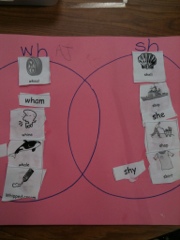
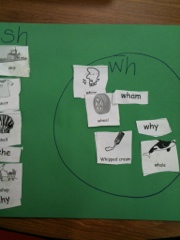
I just viewed an amazing (10 min.) video about Thinking Maps. Pat Wolfe, an educational brain researcher, explained how the 8 Thinking Maps help our brain add visualizations to our learning, so that our brain can remember better. She asserts that thinking maps allow the freedom for higher order thinking to occur naturally and not necessarily with teacher scaffolding. Each thinking map is used specifically for certain types of thinking. I received some training from my school district last year and was amazed at the power of thinking maps. Before, I had consistently used other visual maps including Venn Diagrams and T-charts.

Below are some snip-it’s that I gathered at: http://www.thinkingmaps.com/

A bubble map is used for describing and using adjectives (like writing all the characteristics of a favorite animal).

A tree map is used for classification (like classifying sight words containing 2, 3 or 4 letters).

A circle map is for defining a subject in context (like brainstorming what you know about Poetry).

A double bubble map is used for comaparing and contrasting (spiders/insects) It can be used instead of a Venn Diagram.

A flow map is used for sequencing (ex: listing the sequence of a story, ordinal positions in line) It starts at the left and flows to the right.

A multi-flow map is used for organizing and thinking about cause and effect (why is it raining, what are the effects of rain?).

A brace map is used for organizing whole to part relationships (the parts of an ant: head, thorax, abdomen) and then listing details about each.

A bridge map is used for analogies (I have not used this one in Kindergarten yet!)

Thinking maps are definitely worth your time! I as a visual learner have started using them myself, because I am always itching to organize something!

20120127-063125.jpg

20120127-063134.jpg

20120127-063141.jpg

20120127-063152.jpg

20120127-063205.jpg

No More Letter of the Week?

For more than five years, I taught a letter per week and sometimes every other week. That is just what we did at my former campus, and so did all the other Pre-K classrooms across that school district. I taught letter “Mm” and read stories about monsters, moose, mice and we made crafts based on the “Mm” words we were learning. The students tasted muffins and they decorated letter Mm. This is the letter of the week method. Well, it turns out that this is not the best way to teach children the letter names and sounds. Luckily, I was given the opportunity to use the book “No More Letter of the Week” in my Kindergarten classroom. After using this program for teaching letters, for only one school year, I am sold! I love this method so much and it is more fun for both me and my students. Recently, I began searching for the reasons and research behind the effectiveness of “No More Letter of the Week.”

Stock Image

I came across many articles found at a fellow teacher’s blog: http://www.pre-kpages.com/lotw/It turns out that she embarked on her own research as well. Here is the amazing research:

“Arguments for Moving Away From LOTW

  • Fluent letter recognition is one of the (if not THE) predictors of reading success (Adams, 1990).
  • Removing letters from their meaningful context removes the meaning and purpose from the letter.
  • Children who are taught letters in isolation have difficulty placing that information into literacy activities (Wood and McLeMore, 2001).
  • It is more meaningful to introduce letters as they become meaningful to the students.
  • Just because you and I were taught with the LOTW many years ago does not mean it is the BEST way to teach letters. Remember the Virginia Slims saying “We’ve come a long way baby”? Well, we have come a long way in education and current research supports teaching letters in context and not in isolation.
  • Teaching with LOTW slows readers down, yet it’s too fast for others, it doesn’t meet the needs of all learners and there is no room for differentiation.
  • The students who struggle the most with learning the letters are the ones who are least helped by teaching letters in isolation. They need something to help them make connections – isolating letters doesn’t do that.”

Teaching letters without focusing on a different letter each week

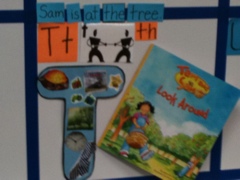
NMLOTW (No More Letter of the Week) teaches the sounds of letters within context of rhymes and motions. Children are selected to be a “Letter Expert” for each letter of the alphabet. The letter expert reads a book from her teacher, which is on her reading level, but contains words with the “special letter.” The letter expert practices the book at home and then reads it to the class. A sentence from the book is then written on pieces of sentence strips and the class works together to put the sentence back together again. The special letter is emphasized while the student teaches everyone about her expert letter. She brings in items beginning with her letter and she also brings in a large letter that is decorated with print and cut-outs from magazines that contain words beginning with the special letter. A special bulletin board or wall is set up by the teacher to display each letter. If the wall is at student level, it can be utilized by the children to reread the sentences using pointers. Their book can also be placed in the letter square. This is a great center, as the letter’s continue being added.

This is a very informative article, that is well worth reading: “N is for Nonsensical” by Dr. Susan B. Neuman http://www-personal.umich.edu/~sbneuman/pdf/nisfornonsense.pdf

20110815-113628.jpg This is the “Reading Wall.” This is the set-up part, before the student use it. I used painters tape on my second white board, to section off the 26 sections (plus 1). When each letter is introduced in the curriculum, one child will be the “Letter Expert,” and take home a large cut-out letter, an emergent reader book (I use little books from the Pearson Reading Street curriculum). Also, inside of the take home bag is a sentence from the book that contains a word beginning with the letter expert letter.

Here is the parent letter that I send home in the take-home bag: Letter expert parent letter

20110912-075116.jpg

20110919-062332.jpg

20110919-062353.jpg

What do you miss about being a child?

Child 1

Image by Tony Trần via Flickr

What was your favorite thing about childhood? I recall catching fireflies, making mudpies, spinning on the tire swing, the smell of fresh cut crass and making forts inside with my older brother. Even though we are adults now, that child is still deep down inside of us, just beggin to have fun!

If you haven’t felt like a kid in awhile, just read the attached list and pick something. The suggestions do not involve money or planning. I promise, you will have fun-and, you will feel like a kid again. So, go out and feed some ducks, play in the rain or pick any of the 48 other ideas. Recently on Linkedin, I met a new author, Helena Harper. She created a list of 50 ways to discover your inner child. Thank you Helena for sharing your ideas that are both simple and fun!

http://www.helenaharper.com/resources/RDYIC-SubscriberFreebie1.pdf

Poptropica is like facebook for children!

Poptropica

Poptropica (Photo credit: grace mcdunnough)

“Poptropica® is a virtual world in which kids explore and play in complete safety. Every month, millions of kids from around the world are entertained and informed by Poptropica’s engaging quests, stories, and games. Kids create a “Poptropican” character to travel the many Islands of Poptropica and use gaming literacy to enjoy a narrative that is often rooted in factual history. Problem-solving skills are honed as kids discover and solve mysteries unique to each Island. There are always new areas to explore in this ever-expanding world where kids can collect objects, read digital books and comics, watch movies, and compete in head-to-head competition. Parents can always trust that their children are playing-and learning-in a safe, online environment.” (direct quote from their website)

I must admit, I felt a little guilty for letting some of my students use Poptropica during free stations (or a no recess day, due to rain) in my classroom. I knew there must be something amazing to it though, and I am so happy to have found out that Poptropica is truly educational fun! I plan to use it as an incentive now in my classroom!

Students can blog too-read all about it!

Ok-I am sold! I will begin blogging with my students. Thanks to my “Kindergarten Teachers United” Linkedin group member, Sharon D., for sharing this idea with me. Kid blog looks so easy to set up and I am about to do it. I am excited to share me and my students journey with blogging in the classroom! Stay tuned for updates!

http://updates.kidblog.org/  “”Kidblog.org creator, Matt Hardy, was featured in the front page story for the Sunday Pioneer Press. Here is one quote from Matt, who is also a 3rd grade teacher in Minnesota:

“With blogs, it’s more about the ideas,” he said. “It’s not so much about the original post as it is about the discussion that follows, that trail of comments that comes afterward.””

What activity or lesson will your students remember?

International Recycle Symbol

Image via Wikipedia

Last year, my students loves our group recycling project. Parents sent in plastic containers and boxes, the week before and students were asked to create “anything.” While learning about conservation, they children had free reign to create inventions and toys. It was amazing to hear them confidently explain what they made and what its use was. One student made a machine out of a milk jug. It was the magic machine, complete with a red button to make it start! Now, I plan to make a “Creation Station” complete with recyclable containers, donated by parents. I am so excited to begin this station for the first time! At home, my daughter made a fashiony outfit out of the trash from the new crock-pot box. Children are so creative! We just have to give them the stuff to create with.

20110728-044903.jpg

Bloom’s Digital Taxonomy…low and high levels of technology!

Have you heard of it? Well, I have heard of Bloom’s Taxonomy, but never “Bloom’s Digital Taxonomy.” So, here it is-and I can’t wait to use it in my classroom! I will outline some key points from Andrew Churches document, based on Bloom’s levels of learning.

1. Remembering (Knowledge)- finding, locating, using a google search or bookmarking, social networking

2. Understanding (Comprehension)- explaining, blog journaling, subscribing, using twitter

3. Applying (Application)- using, executing, uploading, sharing, editing, hacking, playing, running

4. Analyzing (Analysis)- organizing, linking, validating, cracking, organizing, media clipping

5. Evaluating (Critical thinking)- judging, experimenting, critiquing, posting, moderating, blog commenting, reviewing, networking

6. Creating (Creative thinking)- designing, constructing, producing, inventing, programming, filming, animating, video blogging, wiki-ing, publishing, podcasting

I was so happy to stumble upon this information at an article found at the following blog: http://coolcatteacher.blogspot.com/

The original contents comes from a very thorough document created by Andrew Churches:

http://edorigami.wikispaces.com/file/view/bloom%27s+Digital+taxonomy+v3.01.pdf

7 Classroom Steals for Under 10 Dollars!!!

I was so excited to find each of these items for a dollar:

1. Lesson plan book at Target
2. Grade book at Target (both at the dollar aisle)
3. Pointers that look like a white gloved hand at Dollar Tree
4. Mini-chalkboard signs at Michael’s (In various shapes:puzzle piece shape, star, heart and flower….these were .79!!!)
5. Pocket folders at Wal-Mart for .15 each
6.Composition notebooks (the marble looking wide ruled) for .40 at Wal-Mart and Target
7. Elmer’s 2-pack glue sticks for .40 at Wal-Mart

By no means did I feel guilty for buying these!

Have you found any other amazing deals? Please share if you have!

20110728-044642.jpg 20110728-044710.jpg  20110728-045152.jpg

A blog is like a log? Do you agree?

Log of a Spruce tree on end showing ring detai...

Image via Wikipedia

What is a blog, anyway? Have you ever tried to explain it or personify a blog to someone? I suggest using my log illustration. A log was once a tree, but now it is exposed and about to do something more. It might just roll or it may be turned into paper, firewood or structures for a home. All of these are great uses, as long as the log is changing and becoming better. A log is just a log, that may be sat upon. But, it can do so much more than just be! In comparison, a blog was once a thought or idea in someone’s head (either spoken or unspoken). Now, it is a written thought (not just in an e-mail)…and those words might as well be written in blood, because what is online stays online, right? So, this blog is nice, but it is kind of like a log when it is not being used or read. Just being in cyberworld is not special enough. For this blog to be more, it needs others to intervene. The blog must have visitors, subscribers, group members and friends. When this begins, the blog is like a book-it is shared and used. But, the blog must be more than a book to thrive. A book can be closed and put on a shelf to gather dust. To prevent this devastation happening to a blog, the owner must add content often (2-3times/week, according to Ann Handley & C.C. Chapman in their book, Content Rules). When content is added often, then a unique and visual structure is being engineered. However, the key is to keep building and becoming more amazing. So is your blog just a log right now? What stage is your blog in?