Kindergarten Assessment – Easy Breezy!

k assessment

This is a 2 page comprehensive Kindergarten Assessment that will give you a general starting point of what your students DO and DO NOT know. It can also be used to show what your students have or have not learned. One other use is to utilize this as an ongoing assessment, to monitor growth at the end of each grading period!

The “Kindergarten Assessment 1” tool is a great beginning of the year screener to reveal which students are entering K with pre-reading and school readiness skills or not.

The following skills are assessed on these “easy-to-read” and “easy-to-assess” pages:
1. All 26 capital letters
2. All 26 lowercase letters
3. Common letter sounds
4. Simple CVC Word Reading
5. Name Sample
6. Common Shapes
7. Number Identification
8. Number Writing Sample
9. Counting Sets of Objects
10. Rote Counting
11. Simple Sight Word Reading

Directions for Use:
1. Beginning of the Year Assessment – The “Kindergarten Assessment 1” tool can be used as a beginning of the year and end of the year tool to show student growth. Simply print one form and use it for the beginning of the year and then use the second form for the end of the year. Compare and use each form to show student growth.

2. Ongoing Assessment – Growing strides will be evident, and the need for RTI or Special Education intervention, as well. *Suggestion: at the end of each grading period, re-assess and record using a different colored ink pen. Date your data and add a + or – sign. Add up the amount of + signs, then compare between each grading period. Your data will speak for itself!

Click here for the link!

The link above will take you to a sample of the actual Assessment! Enjoy! -Andrea

New! Lesson Plan BUNDLES for 2015-2016

2015-2016 Lesson Plans!!!!!!!!!!

I now have COMMON CORE aligned lesson plans, available for Kindergarten, Special Education Kindergarten and Pre-Kindergarten. All are available below. Just click the link and it will take you to my TpT shop. Look at the menu on the left and everything is organized by category. The link is below:

Common Core Lesson Plans – Click Here! Updated 2015-16

TpTLoveTransparent-03K SpEd Full Year Info

Untitled

20140306-165522.jpg

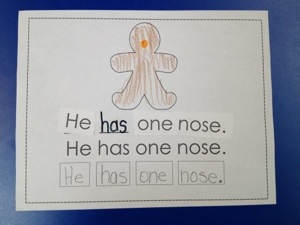
Emergent Reader, Printable Books are also included with many of these lesson plans!

20131215-005506.jpg

Writing Activities are included in lesson plans (see content lists)

20140120-211823.jpg

Here are just SOME of the Emergent Reader skills that are focused on within the included printable books!

20140211-055102.jpg

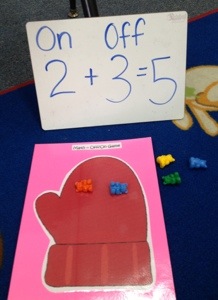
This is one of the Math Workstations (Centers) that is included to help introduce addition.


Special Education Visuals!

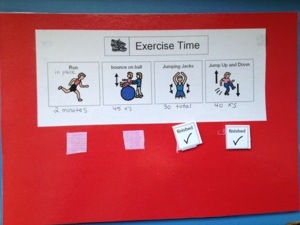
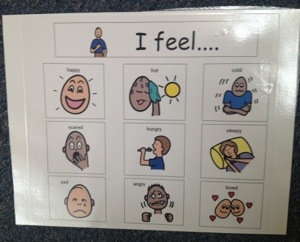
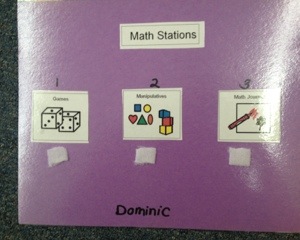
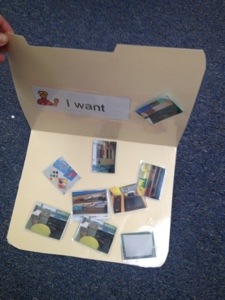
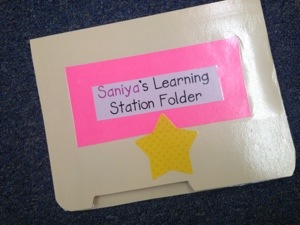
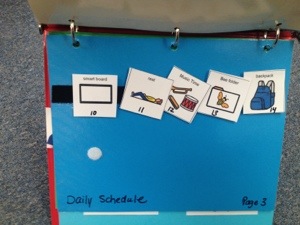
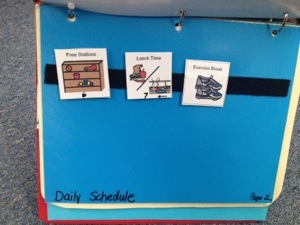
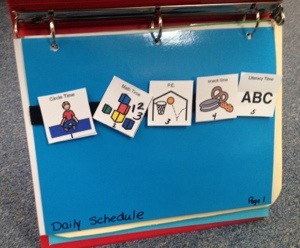
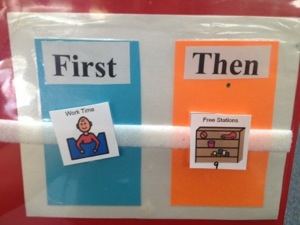
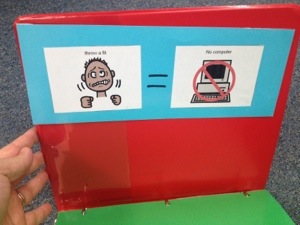
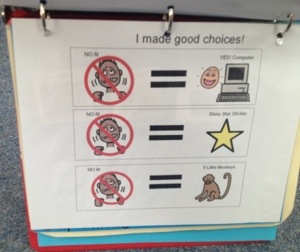
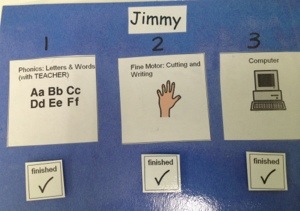
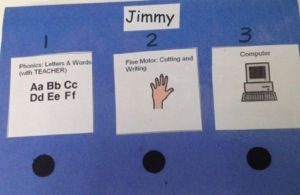
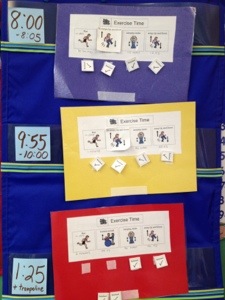
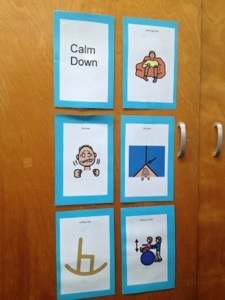
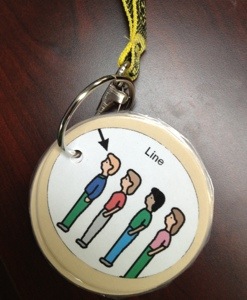
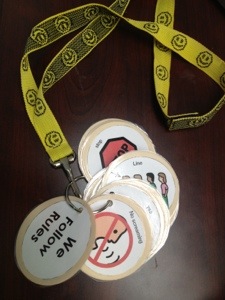
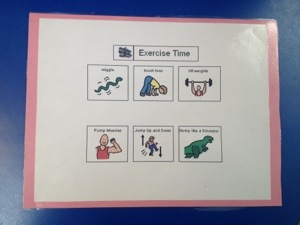
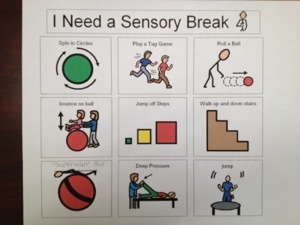
I am once again sharing these charts that I used with some students who benefitted greatly from the visuals. They needed visuals, to help them process the verbal directions that were being given in the school setting. The extra-abilities that they live with are: Autism, ADHD, Down’s Syndrome, PDD, Cerebal Palsy and other multiple cognitive disabilities. A few parents used these visuals at home and they reported that they enjoyed using them there.

When using a visual, the child learns not to “defy,” argue or throw a tantrum with a picture or visual. They learn to comply, because the picture said so.

To assist my students, I have made a handful of visuals that have been successful. Here they are: If I have the link below the picture, then I have the printable available. If not…I’m so sorry, but it is floating around on a jump drive somewhere that I have to locate!

20131001-183438.jpg

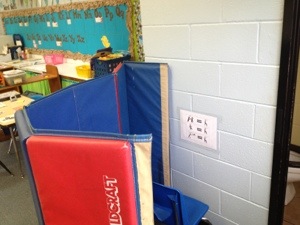
Time Out Corner

20131001-183501.jpg

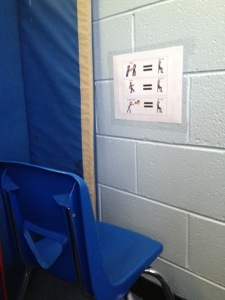
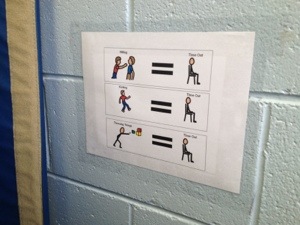
Time Out Chart

20131001-183533.jpg

Here is the link to my FREE time out chart: click here

20131001-183545.jpg

20131002-201918.jpg

20131002-201939.jpg

20131002-201954.jpg

20131002-202002.jpg

20131002-202015.jpg

20131002-202046.jpg

20131002-202054.jpg

20131002-202109.jpg

20131002-202135.jpg

20131002-202200.jpg

20131002-202207.jpg

20131002-202624.jpg

20131002-202641.jpg

20131203-035422.jpg

20131203-035501.jpg

Visual Directions – Click here for the printable link

20131203-045102.jpg

20131203-045113.jpg

20131215-003930.jpg

20140525-225934.jpg

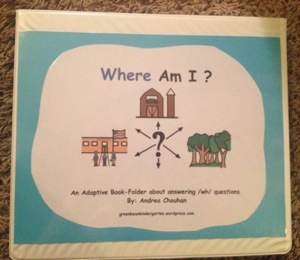
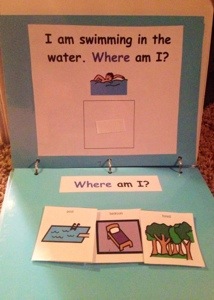
Adaptive Reading Book “Where Am I”– Click here for the link

This is an interactive Adaptive Book answering /wh/ questions- “Where?” I created this book to teach and assess comprehension skills of stories. The question asked is: Where am I? Various answer choices are: bedroom, bathroom, Pizza Hut, shoe store, grocery store, etc…..

20140525-230003.jpg

20140525-230028.jpg

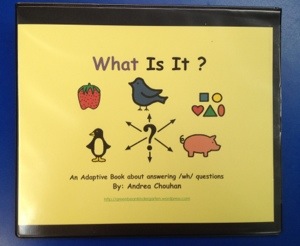
Adaptive Reading Book  “What Is It?”- Click here for the the link

I designed this book (as a special request from another super-star teacher). It is modeled after my other WH question adaptive books: “WHO am I?” and “WHERE am I?” already available for download on my TpT shop. I made these books for my students with autism (one non-verbal and one with limited comprehension skills). They are working wonders! My other students love them as well….there is just something about velcro!

This is also a great “cold read” book to use to have your student read and answer the questions on his own to see if he is comprehending what he reads.

20140525-230038.jpg

How to Make and Use this Book –

1. Print on Card Stock Paper.
2. Laminate.
3. Hole Punch each page, then place them in a 1-1 ½ inch binder.
4. Place the question page and the answer page [top to bottom] so that when the child reads the page, he can see both pages at the same time.
5. The “adaptable” part of this book can be utilized by cutting out the 3 answer choice pictures for each question. (Laminate these also, then attach Velcro to the back).
6. Attach Velcro to the inside of the empty box on the “question” page. This is for placing the “answer” picture.


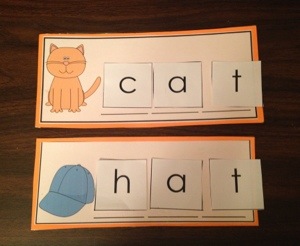
Rhyme Time with the (-AT) Family

20140119-095911.jpg

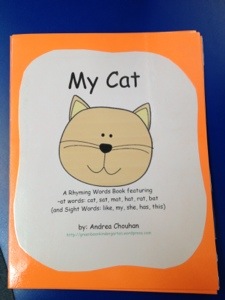
My students absolutely loved this mini-lesson. This is what everything looked like, after I laminated it. The orange “My Cat” book is an easy emergent reader book and is a printable black and white book. It is 8 pages total. This is the teacher copy and it is in color. I printed a black and white paper copy for each child and allowed them to color in the picture on each page.

The featured sight words in this book are: LIKE, MY, HAS, SHE, THIS, IS.

20140119-095926.jpg

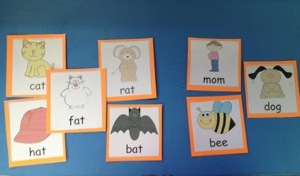
The featured RHYMING words in the “My Cat” book (as shown on the picture cards above) are: CAT, HAT, FAT, RAT, BAT. Vocabulary words shown are: MOM, DOG, BEE.

20140119-095937.jpg

Word Work Station 1: Directions: Practice together in whole group using magnet or practice letters, or even letter card pages (m, a, t, f, b, c) to form the words: rat, cat, hat, bat.

20140119-095945.jpg

(Above) Student book!

20140119-095955.jpg

20140119-100004.jpg

(Above) Word Work Station 2: Directions: Practice together in small group using letter card pages (m, a, t, f, b, c) to form the words: rat, cat, hat, bat. Use glue next. These are the pages that the child gets to take home or save in his/her portfolio!

20140119-100017.jpg

(Above) “Cut Apart Sentences” – Directions-As a whole group, read the story and then pass out the word cards one sentence at a time. Decide the correct order of the sentence and then glue it to a sentence strip. Add the matching laminated picture.

(Below) Word work card

20140531-212240.jpg

There is also more, that I didn’t snap pictures of. I have a parent letter too! You can download the whole Rhyme time kit here:

https://www.teacherspayteachers.com/Product/Rhyming-Words-Kit-Unit-1-at-Words


Phonological and Phonemic Awareness

What is the difference?

The quote below, from the k12reader website explains it perfectly! I couldn’t have said it better myself-so it is a direct quote!

Phonemic Awareness vs. Phonological Awareness

Phonological Awareness is the ability to recognize that words are made up of a variety of sound units. The term encompasses a number of sound related skills necessary for a person to develop as a reader. As a child develops phonological awareness she not only comes to understand that words are made up of small sound units (phonemes). She also learns that words can be segmented into larger sound “chunks” known as syllables and each syllable begin with a sound (onset) and ends with another sound (rime).

Phonological awareness provides the basis for phonics. Phonics, the understanding that sounds and print letters are connected, is the first step towards the act we call reading. 

When measuring a child’s phonological awareness look at his ability to apply several different skills. A child with strong phonological awareness should be able to recognize and use rhyme, break words into syllables, blend phonemes into syllables and words, identify the beginning and ending sounds in a syllable and see smaller words within larger words (ie. “cat” in “catalog”).

Phonemic Awareness  also involves an understanding of the ways that sounds function in words, it deals with only one aspect of sound: the phoneme. A phoneme is the smallest unit of sound in a language that holds meaning. Almost all words are made up of a number of phonemes blended together. Consider the word “ball”. It is made up of three phonemes: /b/ /aw/ /l/ . Each of its sounds affects the meaning. Take away the /b/ sound and replace it with /w/ and you have an entirely different word. Change the /aw/ for an /e/ sound and again the meaning changes.

Phonemic awareness is just one aspect of phonological awareness. While phonological awareness encompasses a child’s ability to recognize the many ways sounds function in words, phonemic awareness is only her understanding of the most minute sound units in words. Because phonemic awareness is a sub-skill under the phonological awareness “umbrella” not all of the measures for determining a reader’s skill level are applied when assessing it. A reader with strong phonemic awareness will demonstrate the ability to hear rhyme and alliteration (the repetition of the same consonant sound at the beginning of several different words used in a sentence or paragraph), find the different sound in a set of words (ie. “bat”, “ball”, “wet”) and blend and segment phonemes.”

In order to READ independently and proficiently at a first grade level, a student must have mastery of both phonological and phonemic awareness. 

Next, comes blending phonemes together into more complex one and 2 syllable words. Words with short vowels, then long vowels…next words with th, wh, sl, tr, cl and then end with those sound combinations. 

Finally, students will then learn words ending in silent “e” and words containing specific spelling combinations, such as CVVC (ou, ea, oa).

Mastery of reading at a first grade level is so vital, according to Fountas & Pinnell. Students will then be able to gain the skills needed to move on to reading at a 2nd grade level. 

A Solution to an Everyday Problem with Young Learners

h

We all have students who have trouble with fine motor skills. Every year, it seems like more and more kids need help opening their snack or milk container, buttoning their coat, and holding a pencil. While some of these students receive services like occupational or physical therapy, there is limited funding to help general education preschool or kindergarteners with these issues. With Common Core Standards shaping the direction of our teaching, something must be done early on to help our students facing these challenges.

The Hands First! Curriculum offers a solution to these problems. Principals, Superintendents, and Directors of Pupil Services support this curriculum as it is a Level 1 Response to Intervention Model and only takes 15 minutes daily for 4 months. Administrators also approve this program because it was written for use with common classroom materials without the need for additional supply purchases.

Created by Professionals, used by teachers and parents alike, “Hands First!” is definitely worth checking out! Even if you have just one student who just can’t seem to grip that pencil correctly or zip up their jacket.
Check out their website and follow their blog: www.handsfirstforlearning.com
Like them on Facebook:
https://www.facebook.com/pages/Hands-First-for-Learning/487664548029376

Everything is on sale 25% using WINTER15 code when checking out
Hands First for Learning accepts purchase orders!

hands first logo

My Magical Classroom in Photo’s!

When I walk into my classroom, I feel like I am in a fairy tale! I love reading, books and fairy tales and I want my own children and students to love reading as well. Surrounding them with stories and reminders to read is my tactic- haha!

20140809-135709.jpg

Shown in the picture above is my reading corner. I found those cute and comfy chairs, both from Target – for under $30! The letters that say READ are chipboard letters that are covered in rhinestones. My daughter and I had fun creating them! The little brown rug is a gem that I found at Ross for $11. I love great deals! The castle turret on top of the book shelf is a simple box that I cut and sponge painted with 44 cent gray acrylic paint.

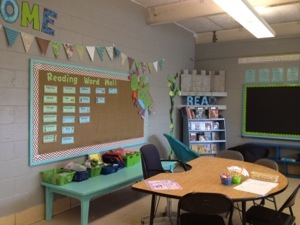
Small Group Learning Area – This is where I do most of my teaching. The blue table behind the semi-circle table, holds all of my supplies for the day and week. Prior to school starting, the table was black and white polka-dotted. It was screaming to be painted! The bulletin board is covered in simple burlap and is the Reading Word Wall. I add “words/skills” as we cover them.
20140809-135726.jpg

This Dragon is “Hot for Learning!” – I actually drew this little guy out from a paper box and then painted him with 44 cent acrylic paint from Wal-Mart. The pennant banner is simple scrap book paper, from Wal-Mart and is stapled to thin satin ribbon. I found the “Reading Word Wall” caption letters at Michael’s!

20140809-135734.jpg

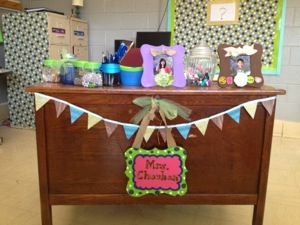
My Teacher Pad – I made a min-pennant banner with the same scrapbook paper. Actually, these are the same pennant banners that I used in my classroom last year. Last year, I used the same color scheme. I made my name sign with a chip board sign and acrylic paint. The frames on my desk are from Micheal’s and were just $1. I was too worn out to paint my filing cabinets, so I just hot-glued my left over material to the side of one! It is the same material that I used for the bulletin board behind my desk.
20140809-135745.jpg

“The Mystery Word of the Day” – I place the definition of a word on this bulletin board and the students have to use their resources (ask an adult, use the internet or a dictionary) to find the correct vocabulary word. Anyone with the correct answer earns $5 in classroom cash!This lovely material is from Hobby Lobby.

20140809-135753.jpg

Computer Corner – So, the backpack hooks are above the computers. I didn’t want to rearrange the furniture, so I added extra material to jazz up the wall above the computers. I’m still not loving it 100%, but it will do for now!

20140809-135803.jpg

Entrance Area – This is not very fancy, yet! The door to enter my classroom is to the left of my schedule.

20140809-135814.jpg

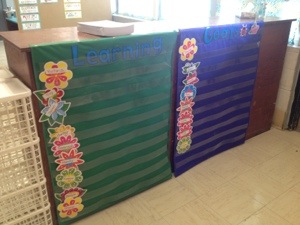
Learning Goals Chart – Each flower has a students’ name on it, and (now) I have target skills beside the names.
20140809-135821.jpg

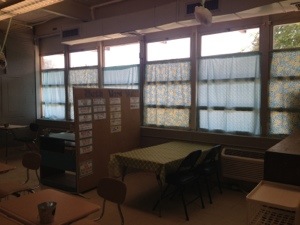
Math Corner –  I made these with “No Sew Glue” from Wal-Mart. It was fun! The table below is covered with a lime green table cloth from Dollar General and the room divider contains the Math Word Wall. This is a quiet area where children work in partners.
20140809-135832.jpg

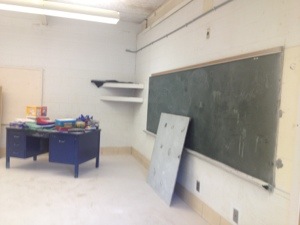
Front and Center – This chalkboard was formerly green and dull. I painted it with chalkboard paint from Ace Hardware (which was half the price of Michael’s). Below the Smart Board is a shelf that contains Language and Math materials. I changed the desk arrangement from what is displayed in the picture. The desks are now back to pack so that the students are not facing each other.

20140809-135839.jpg

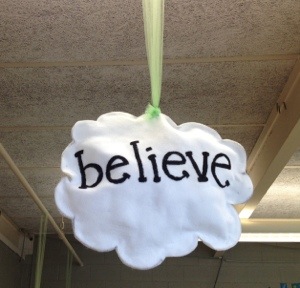
Clouds of Inspiration – I absolutely cannot make those cute tissue paper flowers that hang from classroom ceilings. So, I used white felt, hot glued 2 pieces together and stuffed them with whatever I had lying around (paper towels, scrap felt, etc…). I painted the letters with acrylic paint after I wrote it with a sharpie first. I hung 5 cloud from the light fixtures, using see through ribbon.
20140809-135846.jpg

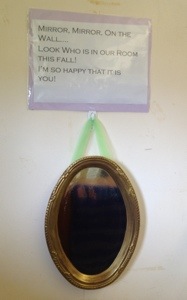
Mirror, Mirror – I have this hanging for all to read, upon entering the classroom. I made it with a silver colored tray from Dollar Tree. I painted gold acrylic paint around the edges (about 3 coats).
20140809-135851.jpg

Curtains, Again! – I used these in my classroom last year. I created them by stapling the green material down at the top and then hot gluing blue ribbon over the staples.

20140809-135921.jpg

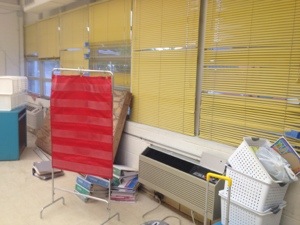
Before Pictures!
20140809-140002.jpg

20140809-140025.jpg

20140809-140042.jpg

20140809-140108.jpg

Special Education in Kindergarten…Curriculum, Easy Readers and Lesson Plans Galore!

Untitled

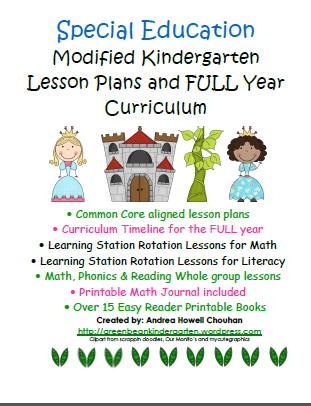
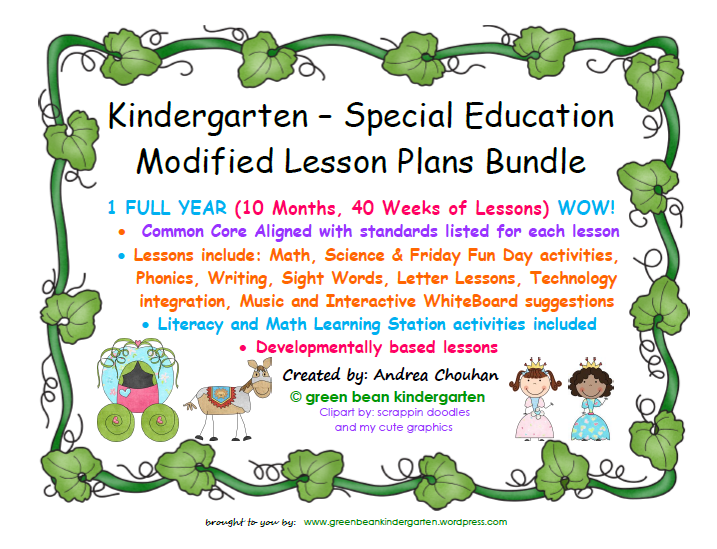
Introducing my Kindergarten Special Education Lesson Plans!!!!! These plans are also Common Core state standards aligned and they are developmentally appropriate for special needs children ages 5-7. I created these lesson plans last year, while teaching Kindergarten Special Education. I had 9 students ranging in various exceptionalities such as: Autism, Downs Syndrome, developmental delays, Cerebral Palsy, ADHD, and ADD. Although these plans are standards-based, I also show teachers how to organize Learning Stations for Math and Literacy and teach small whole group lessons as well. The full curriculum is 210 pages long, which I have also bundled together.

For a limited time, I would like to give you a FREE week of these Special Ed Kindergarten plans! You can download it here: http://www.teacherspayteachers.com/Product/Kindergarten-Special-Ed-FULL-WEEK-of-Lesson-Plans-or-Sub-Plans-by-GBK-1006586
K SpEd LP image

Kinder Special Education FULL YEAR Lesson Plan Bundle:

http://www.teacherspayteachers.com/Product/Kinder-Special-Ed-FULL-YEAR-Lesson-Plans-and-Curriculum-by-GBK-1318584

K SpEd Full Year Info

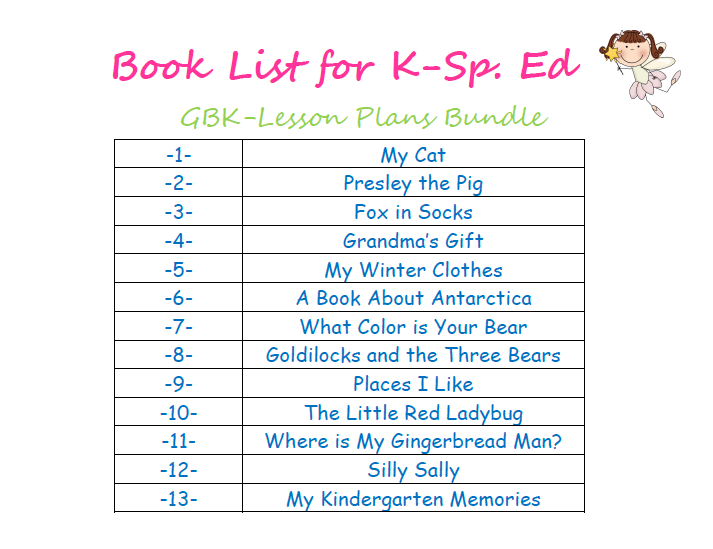
Easy Reader Books that come with the bundle!
K SpEd Book Bundle Cover

All of my huge bundles (in PDF and zip files) are on TpT. However, if I made available a paypal store, here on my website, would you rather download/buy from my website? Or, is TpT sufficient? It’s just an idea that I am rolling around in my head. I’d love your feedback. Thanks! “Summer is not over yet!” -Andrea

castle