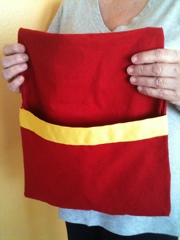
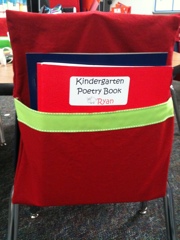
My mom made these beautiful chair pockets for my kindergartener’s chairs. I can’t wait to surprise my students with these on Monday! She bought the material from Hobby Lobby along with the gross grain ribbon in yellow, green and blue. I had an old and very worn chair pocket, given to me by a previous teacher. She used that as her pattern. My mom was amazed to see video’s on You Tube and instructions on Google-for free. How wonderful to live in the information age!
I am so excited that now my students will have a place to keep their reading, writing, math and science journals in.
My mom came and unveiled the chair pockets, after school today. See the baskets in the middle of the table? All those journals and folders will be in the chair pockets tomorrow-yeah! Thank you Mom, for sewing these amazing chair pockets!
Have you ever seen a five year old, of average intelligence, write her own little book out of folded construction paper? Last year was my first year teaching Kindergarten students how to be authors. I was inspired by the book Already Ready by Katie Wood Ray and Matt Glover. I was skeptical at first, until I saw my daughter start writing her own mini-books. She was also a Kindergarten student at the time. I now have a collection of her original works as a five year old author, from August to May. This year, I launched my Writer’s Workshop again. Here is how I began.
First, I folded and cut one piece of white construction paper into 1/4th’s and then stapled it. I had one for each child made before the lesson. Next, I started a mini-lesson and read a “mentor text” -a simple Dr. Seuss book (“I Can Read With My Eyes Shut”). I showed how the author drew pictures and wrote words to match them. I explained how the author stayed on topic and wrote about reading, and not flowers. Next, I explained to my students that they are authors and illustrators too and that they would start making their own books. I showed them the little book and told them how I was going to write a book of my own about cats, because I like cats, a lot. So, I began writing simple sentences on each little page. Page 1- “I like cats.” Page 2- “I like orange cats.” Page 3- “I like striped cats.” Page 4- “I like black cats.” Page 5- “I like little cats.” “The end.”
I asked my students to think about what they like and what they would like to write about. Amazingly, it took only seconds for them to think and tell their buddy what they wanted to write about. I heard these ideas from my students: “race-cars!” “lipstick,” and “puppies!” Finally, I gave each child a little tiny book and they began writing. I reminded them to write their title first and their name, since they were the authors. I must say, I was so amazed by their cute and simple illustrations. Most students wrote no words yet, but that is ok, as Katie Wood Ray asserts in her books. Illustrations can tell a story and this is how we encourage students to begin reading-to look at the pictures and tell what is happening. So, this is how we encourage writing, by beginning with illustrations.
After about 5-7 minutes of writing, I told the students that we would have to stop for now and continue writing tomorrow, during our Writer’s Workshop. They begged for more time, but I showed them their brand new Writer’s Workshop folders (pocket folders) where they would put their little books. My student’s were so proud of their books. The next day, I had them begin on the rug with their books and “read” their books to a buddy. I paired up each student with a buddy, to make it less chaotic and to ensure that each child had someone to “read” to. After a minute of sharing, I instructed them to go back to their tables and write some more.
In my next postings about writing little books, I will address what to do with those students who just scribble or only write their name on each page, if even that. To read more about Katie Wood Ray and Matt Glover’s books about writing, follow this link: http://www.heinemann.com/shared/onlineresources/E01073/RayAlreadyFlyer.pdf
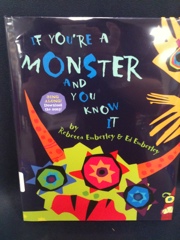
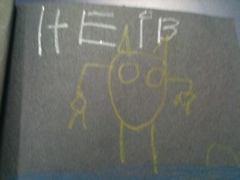
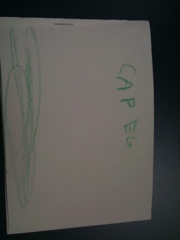
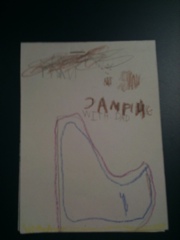
The use of color inspired my little ones. We noticed how the illustrator chose to use black paper for her book and how it made the book for colorful and spooky! So, we decided to write our own spooky books! Many students wrote about monsters too!
Title "Dragons, Alligators and Monsters"
Jackson wrote: "I see a monster"
"The alligator"
"He has no mouth or nose"
"The end"
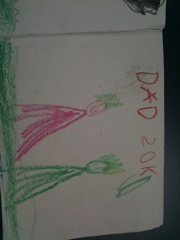
Ryan’s book about “Camping With Dad.”
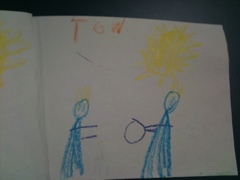
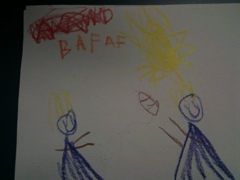
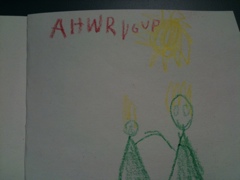
Since it is the beginning of the year, Kindergarten students do not yet understand the cocept of "sounding out" words to write them. Many of them are at the phonetical or pre-phonetical stage of writing, which is actually developmentally appropriate. However, I help them to "sound out" titles for their books by making a running list. This is the list that we compiled before writing in the little black spooky books.
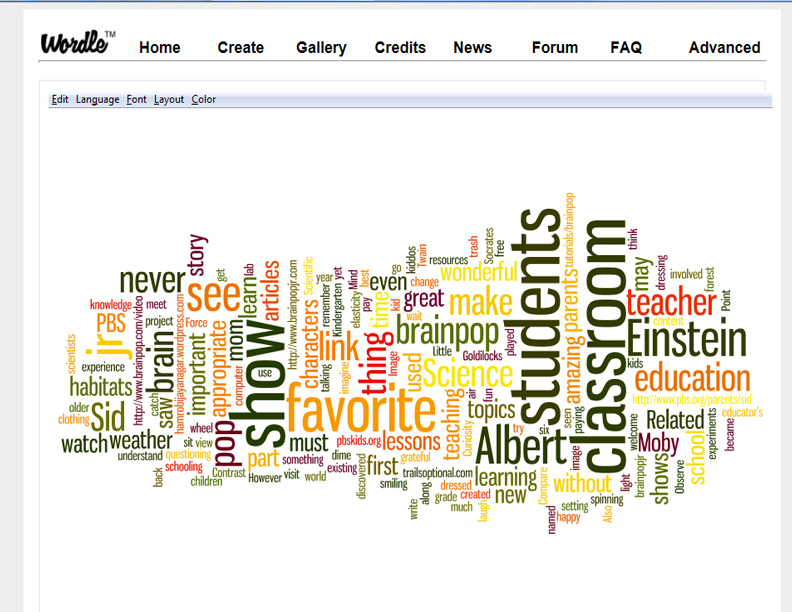
I made this at www.wordle.net By typing in my blog site, the words that I used the most in my entire site came up the largest. It kind of shows the priorities that I write about in my posts.
My son used the site with his spelling words. He typed them instead of writing them for his homework. This is another fun way to infuse paper-pencil homework with technology. When my daughter was in first grade, her teacher also allowed her to type her spelling words, instead of hand write them. Then, I helped her to email them to her teacher. She loved it and it made her feel so grown up!
Kindergarten welcome Power Point This is what I plan to show to my parents and students during “Meet the Teacher.” I am so excited and can’t wait to meet my new bunch of smiling kiddos!
Please add your favorite quote, if you don’t see it on my list. Thanks! If you don’t have a favorite that resonates with you, then sit back and be inspired!
“Tell me and I’ll forget; show me and I may remember; involve me and I’ll understand.” -Chinese proverb
“I cannot teach anybody anything, I can only make them think.” -Socrates
“Educating the mind without educating the heart is no education at all.” -Aristotle
“Imagination is more important than knowledge.” -Albert Einstein
“The only thing that interferes with my learning, is my education.” -Albert Einstein
“The important thing is not to stop questioning. Curiosity has its own reason for existing.” -Albert Einstein
“I have never let my schooling interfere with my education.” -Mark Twain
“You must be the change that you want to see in the world.” -Gandhi
“Most people are about as happy as they make up their minds to be.” -Abraham Lincoln
Have you seen Sid the Science kid, yet? The first time I saw my six year old watch this show on PBS, I saw how involved she became. The characters are interactive and when I watch the show, I learn something new about Science. It is amazing to see these students in the classroom and home setting. In the classroom, the teacher shows the children the steps of the scientific method: “Observe! Compare! Contrast! Describe!” Scientific journals are also used in Sid’s classroom. I get some great teaching ideas from Sid. I am grateful that PBS has created such a wonderful learning experience for our youngest scientists!
The best part of this show is that you can show students each episode, from your computer-at school! I project it onto the screen in my classroom and then my students take part in many of the activities afterwards. For teacher resources, you can visit this link: http://www.pbs.org/parents/sid/ Also, I discovered a blog, where a mom and her boys, test out experiments from various episodes. How amazing! Here is that link: http://www.pbs.org/parents/sid/blogs/parents/
These are some of the topics that Sid teaches:
Exploring habitats
Little creatures in a forest
Sid and his mom talk about air pollution
Force, inertia and elasticity
Friction, light, and shadows
Ways to make less trash
Internet Safety
Recycling
There are even games that go along with each topic. I just played the weather game. I had fun spinning the weather wheel and then dressing up the character with appropriate clothing! You can even sing 1-2 minute video song clips about his Science topics. What I like the most is that this program and interactive website meets children where they are at. It encourages critical thinking by asking higher level questions, like why? and how? Sid models collaboration as he engages in problem solving discussions. The children are engaged as they learn from Sid! Most of the games on this site can be played on the interactive whiteboard as well.
Sid has an “Investigations” clip video where a real class makes applesauce. Our class viewed the short clip from http://www.pbskids.org and watched how the students figured out the best way to use heat to make applesauce. We then decided that we needed ingredients and a recipe. So, for shared writing, I wrote what they children shared!
Then, I had each student then cut up about ten apples. They did it with plastic knives and has so much fun! They then added them to the crock pot along with sugar, water and cinnamon. We cooked it from 10am to 2:30pm on high heat. At 2:00, I let them each stir and mash the cooking apples. Then when the applesauce was ready, I scooped it into a cup, gave them each a fork-and they enjoyed. Every single student enjoyed eating it! I can’t wait to do it again next year!
This is what the apples looked like at 2:00.
Yum! This is how we enjoyed eating our applesauce!
If you have never used brain pop jr. or brain pop…you have to try it! Educators and parents can use brainpop jr. It is appropriate for younger students (I would say up to first grade). However, brainpop ,is for older kids. There is a cute little robot named Moby that guides the lessons and his friend does all the talking and explaining. It has such great content and depth, but is at the children’s level. One of my favorite lessons is about story characters. Moby gets dressed up with a Goldilocks wig and re-enacts the story. Hearing my students laugh and learn, at the same time, is such a wonderful thing to see! Some of my other favorite topics on brainpopjr. are: recycling, animal habitats, space, rocks & minerals, holidays, bike safety, family and so much more! Their website is: http://www.brainpopjr.com
So, there is a catch. Daily video’s are free. To view everything, you must subscribe. I never had to pay a dime because our PTO paid for it. You may even could write a grant to cover the costs. It is worth every penny, though. If my school ever stopped paying, I would do it myself. I cannot imagine teaching Science or Social Studies without brainpop jr.!
These are cereal boxes that I cut, and I plan to use them for my book boxes in my classroom. “The Daily 5” book is a great teacher resource, that gives simple ideas about how to instill more reading into your classroom routine. I have only used “The Daily 5” for one year, but I love it and am excited to use it even better this school year. Last year, I used magazine file boxes, that had been given to me-brand new. They did end up falling apart, and I had to tape the bottoms up with book tape. But they lasted for the school year. However, I did not want to go through the same thing again and decided to make my own book boxes-for free. I just need at least 15 more boxes to start out the school year. My parents and family have been instructed to save them up for me!
So, what is “The Daily 5”? Authors, Gail Boushey and Joan Moser have created these five components to encourage daily reading in the classroom:
1. Read to Self– This is silent reading time. Last year, I began the first 15-20 minutes of the day with silent reading. The students used their book boxes to read. Every book in the box was on the students’ reading level, with nothing too hard or too easy. I allowed students to change books out every few weeks.
2. Read to Someone- This can be buddy reading or reading with a partner. I incorporate this step into my Reading Center, where there are usually 2-3 students at a time. I think that the more students read, the better readers that they will become, as a result.
3. Listen to Reading– I incorporated this into my daily read-alouds. Since I love reading and I love reading to children, I usually read about 2-3 books a day to students. I believe that when children hear more reading, they enjoy more reading.
4. Work on Writing– I this into my Writing Center, where I have pre-stapled books available for students to write and illustrate their own “little books.” Last year, this was the most popular station in my classroom! Writing develops reading skills too!
5. Word Work- I also make this a Center station. I change the activity every 1-2 weeks. This is where I include activities for the phonics skill, which I work on during Guided Reading groups. So, if the skill is -at words, th- words or beginning sounds-I place an activity about it here.
I absolutely love books! I always teach my students that books are like money-so treat them well. As a child, I always enjoyed reading as a hobby, but I developed a love for books because of my seventh grade teacher, Mrs. Dalyrymple. She was always bringing in a new book to read, that she had just bought at a second hand book store. I don’t even remember any of the books that she read, but I do remember her excitement and joy that came from reading a book aloud.
As a teacher and mom, I can’t help but do the same thing. Books excite me-especially when I find one for less than a dollar at the Goodwill store. I hope that I awaken a love for books and learning, within my students too!
Here are some of my favorite books, that I love to read at the start of a new school year!
This is my newest favorite. It is such a cute story about how the classroom of students made a gingerbread man and then went out to recess. When they came back-he was gone. Now, they must search the school to find him. Along the way, he is out searching and meets the staff a the school (the nurse, principal, librarian, coach). It also comes with a poster of the cute gingerbread man from the book, which has a black and white copy to reproduce for your kiddos!
I want to use props this year to let students help me act out the story (lunchbox, sandwich, mouse stuffed animal). I think it will be very interactive this way.
I like to think-aloud as I read this lovely story, and have the students help me compare the Kindergarten classroom in the story (full of animals) to our classroom.
This is the Reading Station. Each basket is sorted by theme based on the books that I own (fairy tales, Dr. Seuss, Eric Carle, Jan Brett, animals, insects, ABC and numbers. I also have animals and hats for role playing.
I traced some puzzle pieces (floor puzzle) to make this bulletin board. Once I get my student roster, I will be writing each child's name on each puzzle piece!
These cute ABC kids signs are from Lakeshore Learning store. I will be ticky-tacking the sight words under each letter, as I introduce them.
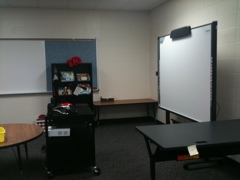
This is the Hitachi interactive whiteboard that I have for student use. Check out the cool laptop cart, to go along with it (complete with projector)!
This is the Guided Reading group table-where all the phonics magic of reading will happen!
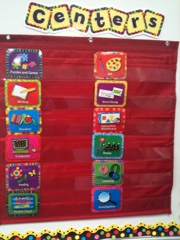
I got these cute Center/Workstation labels from Teacher Heaven. I plan to assign 2 students per station, to minimize behavior problems.
My new easel arrived! It is magnetic. I plan to use it for my morning message that I write to the students each morning. The rules poster will be completed as a class together. Then each student will sign on the bottom.
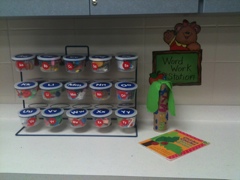
My school bought these nice letter/sound tubs from Lakeshore Learning. They have cute little objects inside, for each letter. The tree you see was made out of a Pringles can, felt leaves that I cut out and glitter sticker letters that I got from Wal-Mart.
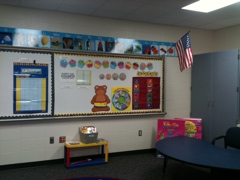
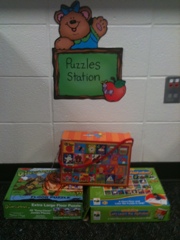
I ran out of shelves, so I placed my puzzle center under the Calendar area board. The students will be making the puzzles on the floor anyways!
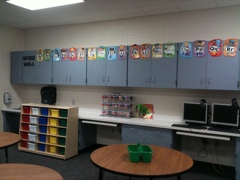
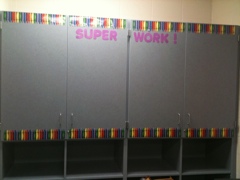
I will be hanging student work here!
My big book station is tucked nicely on a shelf with the books laid flat.



















 green bean kindergarten